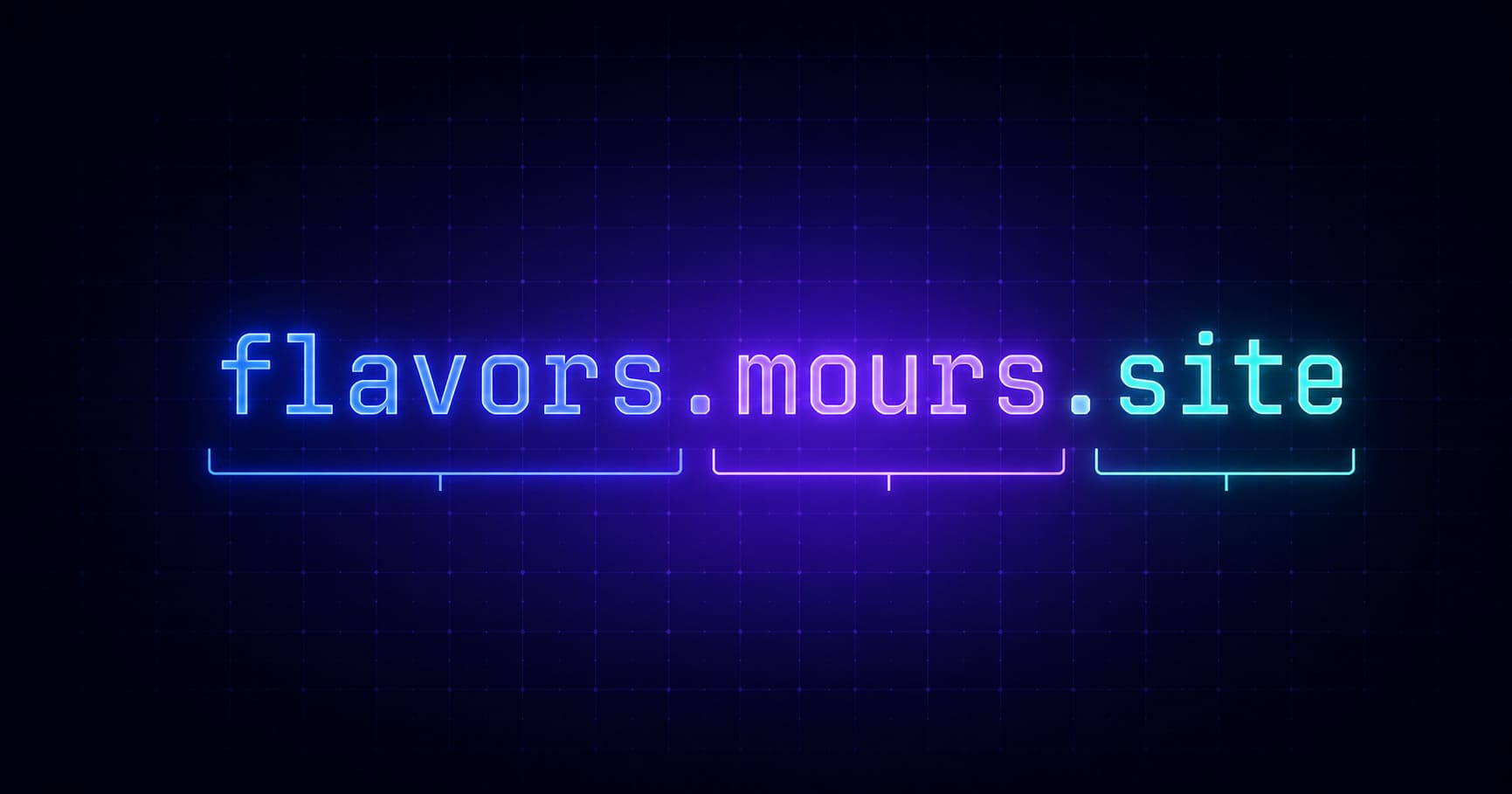
Someone shares their new MakeOurs site with you. The link is flavors.mours.site. You click it — a nice landing page for a food business loads. But you are puzzled. What exactly is mours.site? And what is the bit before it — flavors? Is that a domain? A subdomain? Something else entirely?
If you are building your own site on MakeOurs and wondering what your free URL actually means, this guide explains it in plain language — no technical background required. By the end, you will know exactly what a subdomain is, how it works, why MakeOurs gives you one for free, and when you need something different.
1. Start Here: What Is a Domain Name?
Before we get to subdomains, it helps to understand what a domain is.
A domain name is the address of a website — like google.com, zomato.com, or makeours.com. It consists of two parts:
- The name part:
google,zomato,makeours - The extension part:
.com,.in,.org
When someone types makeours.com into their browser, the internet's address system (called DNS) looks up which server holds that site and loads it. The domain name is a human-readable alias for that server's actual address.
Domains are registered and owned — you pay a registrar a yearly fee (typically ₹700–₹1,500 for a .com) to own the rights to use a specific domain name.
2. What Is a Subdomain?
A subdomain is a prefix added to the left side of an existing domain, separated by a dot.
Format: subdomain.domain.extension
Real examples:
blog.makeours.com— the blog section of makeours.comsupport.zomato.com— Zomato's support portaldocs.google.com— Google's documentationflavors.mours.site— a MakeOurs user's site on the shared mours.site domain
The key thing to understand about what is a subdomain: a subdomain is created and controlled by whoever owns the parent domain. MakeOurs owns mours.site. When you create a site on MakeOurs, MakeOurs creates a subdomain of mours.site using your chosen slug — for example, yourname.mours.site.
You do not need to buy or own anything. MakeOurs creates the subdomain for you on their domain, and your site is immediately accessible at that address.
3. Breaking Down a MakeOurs URL
Take the URL flavors.mours.site:
| Part | Value | What It Means |
|---|---|---|
| Subdomain | flavors |
The unique slug chosen by the MakeOurs user |
| Domain | mours |
The domain name owned by MakeOurs |
| Extension | .site |
The top-level domain extension |
| Full parent domain | mours.site |
The shared domain MakeOurs uses for all free sites |
Your subdomain (flavors) is what makes your URL unique among all MakeOurs sites. No two MakeOurs sites can have the same slug — once you claim flavors.mours.site, nobody else can use it.
4. Subdomain vs Custom Domain — What's the Difference?
This is the comparison most people want to understand:
| Free Subdomain | Custom Domain | |
|---|---|---|
| Example URL | yourbusiness.mours.site |
yourbusiness.com |
| Cost | Free | ₹700–₹1,500/year + paid MakeOurs plan |
| Setup time | Instant on publish | 15 min setup + up to a few hours propagation |
| SSL/HTTPS | Automatic | Automatic on MakeOurs |
| Search ranking potential | Limited (shared domain) | Full (dedicated domain) |
| Professional email | No | Yes (with separate email hosting) |
| Appears in Google as | Subdomain of mours.site | Your own independent domain |
A subdomain is not inherently inferior to a custom domain — but it is a shared address. Your site exists within mours.site, not on its own independent web address. For most small business uses, especially getting online quickly and affordably, a free subdomain is a perfectly good starting point.
5. How Subdomains Work (The Simple Version)
When you type flavors.mours.site into a browser, here is what happens:
- Your browser asks the DNS system: "Where is
flavors.mours.site?" - DNS looks up
mours.siteand finds the DNS records MakeOurs has set. - Those records include an entry for
flavorsthat points to the MakeOurs server hosting that specific site. - Your browser connects to that server and loads the site.
This is identical to how any website loads. The only difference between a subdomain and a root domain is where in the DNS hierarchy the address is configured. Visitors do not experience any difference in speed or reliability between a subdomain and a root domain on the same hosting infrastructure.
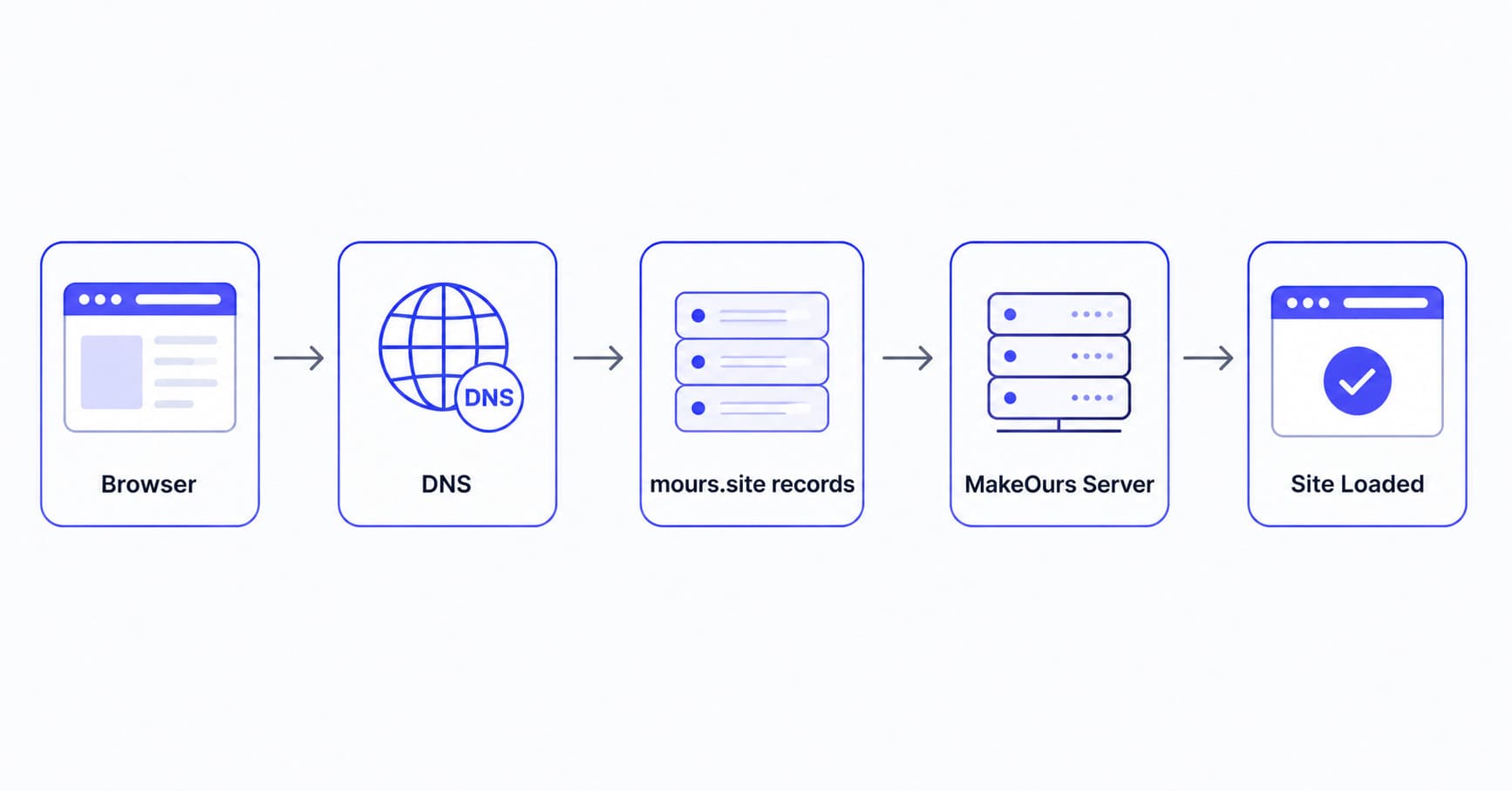 When a visitor types your mours.site URL, DNS resolves it to the MakeOurs server hosting your specific site — the same process that loads any website.
6. Why MakeOurs Gives You a Free Subdomain
Most website builders charge for hosting separately from the builder itself. You buy the tool, then you buy the hosting, then you configure the domain, then you wait for DNS. It takes time and multiple paid services.
MakeOurs reserves your mours.site slug the moment you start building — no registrar account needed, no DNS panel, no hosting provider to set up. That part is free on every plan, including free.
What is gated is going live on it. Building and previewing your site with the full AI generator and visual builder costs nothing. Actually publishing — making yourslug.mours.site reachable by the public — requires a Pro or Business plan. This is a deliberate split: MakeOurs lets you get your site completely right, for free, before you ever pay to put it in front of real visitors. Build your site, share the preview with a few people for feedback, and upgrade only once you're ready to go live.
7. When to Move From Subdomain to Custom Domain
The free subdomain is the right choice when:
- You are still building and testing your site and not ready to go live yet
- You want to see the finished design before paying anything
- Cost matters more than branding right now, once you do publish
A custom domain makes more sense when:
- You want
yourbusiness.comin your URL - You want a professional email address at your domain
- Long-term SEO is a priority
- You are including the URL in formal proposals, printed materials, or a Google Business Profile that you want to rank
Both publishing on the free subdomain and connecting a custom domain require a paid MakeOurs plan (Pro or Business) — the difference is just which URL your live site uses. Visit makeours.com/pricing for current options.
8. Frequently Asked Questions
Q1: What is a subdomain in simple terms?
A subdomain is a prefix added to an existing domain name. In yoursite.mours.site, the subdomain is yoursite and the parent domain is mours.site. MakeOurs owns mours.site and creates a free subdomain under it for every user's site.
Q2: Is a subdomain the same as a landing page?
A subdomain is an address — the URL. A website is the content at that address. Your MakeOurs site is the landing page; yourslug.mours.site is the subdomain address where visitors find it.
Q3: Does a subdomain hurt my Google ranking?
Subdomains can rank in Google, but they are treated as part of the parent domain rather than an independent site. For local and specific search terms, a mours.site subdomain can still appear in results. For long-term SEO growth, a custom domain gives you more control and potential.
Q4: Can I have multiple subdomains on MakeOurs?
Each MakeOurs site you create gets its own subdomain. If you create multiple sites, each gets a different yourslug.mours.site address.
Q5: What happens to my subdomain if I upgrade to a custom domain?
Your mours.site subdomain typically remains active after connecting a custom domain. Your custom domain becomes the primary address.
9. Conclusion: Free to Build, One Upgrade Away From Live
A subdomain is simply a prefix on an existing domain. MakeOurs reserves one free for every site — yourslug.mours.site — no domain purchase or DNS configuration needed. Build your entire site against that address at no cost; publish it live, HTTPS-secured, the moment you upgrade to Pro or Business.
Understanding what a subdomain is demystifies the URL you'll eventually share with customers. It is not a full custom domain, but once live it's a real, working, globally accessible web address.
Start free. Build your site fully. Publish when you're ready, and move to a custom domain whenever it makes sense for your brand.
Build your site free — no credit card needed to get started. Start Building on MakeOurs
External References & Further Reading:
- Cloudflare Learning Center: What is a subdomain
- MDN Web Docs: Anatomy of a URL
- ICANN: How domain names work
For more guides on understanding and building your MakeOurs site, visit our Blog section.